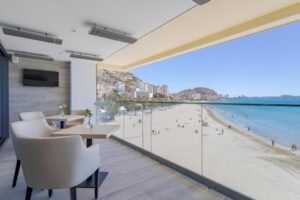
There are mornings on the Explanada when the light is soft, the palms barely stir and Alicante feels entirely itself. And then there are mornings when a white wall of balconies rises beyond the marina and several thousand extra people step ashore before you have finished your first coffee.
Cruise tourism in Alicante is booming — and it is reshaping the city faster than many residents realise. The forecasts for 2026 speak of 113 ship calls, around 325,000 passengers and an estimated €84 million economic impact. Last year was already considered historic, with just over 100 calls and roughly a quarter of a million visitors arriving by sea. The curve is steep, and it is pointing upward.
On paper, the story is triumphant. More visitors. More spending. More global exposure. Mayor Luis Barcala has framed cruise growth as proof that the city is consolidating its position as a Mediterranean homeport rather than a fleeting stop on someone else’s itinerary. He speaks of culture, gastronomy and heritage. Of an Alicante that is not merely sun and sand but substance.
There is, undeniably, money in it.
The arithmetic behind cruise tourism in Alicante
Cruise economics is not just about headcount but behaviour. A passenger embarking or disembarking here — a homeport traveller — spends dramatically more than someone in port for six hours. Industry figures suggest average spend north of €400 for a homeport passenger, versus around €80 for a standard day visitor.
That difference matters. It means hotel nights. Restaurant bookings. Airport transfers. Real retail. Not just a quick coffee and a magnet.
From around 18,000 cruise passengers in 2017 to a projected 325,000 next year, the growth feels less incremental and more structural. And structural growth changes cities.

Where do they go?
The obvious draws are predictable: Castillo de Santa Bárbara, rising theatrically above the bay; Mercado Central de Alicante, fragrant and photogenic; the marina; the Old Town; the broad sweep of the Explanada itself.
But cruise tourism in Alicante does not stop at the city limits. Coaches head towards Elche and its palm groves. Inland towards vineyards and mountain villages. And, inevitably, towards Benidorm, that unapologetically vertical slice of Mediterranean tourism which absorbs volume with practised ease.
The economic ripple spreads across the province. So, quietly, does the impact.
Mercado Central: charm, theatre and tilt
The question for cruise tourism in Alicante is not whether change is happening — it is how much change the city wants. Mercado Central remains, fundamentally, a working market. Locals still buy fish, meat, olives and fruit here. It smells of produce rather than perfume.
But look more closely and the evidence of touristification is already there. More and more stalls now double as tapas counters. Wine glasses appear where once there were weighing scales. High tables edge into spaces once reserved for crates of vegetables.
For many visitors, this is delightful. It brings energy. It extends opening hours. It makes the market somewhere to linger rather than simply shop. It is, in many ways, a good thing.
Yet it is also a visible shift: a gradual tilt from neighbourhood larder towards curated experience. Nothing collapses overnight. The question is whether that balance is watched and managed — or simply left to market forces and cruise timetables.
Spreading tourism through the year
One of the more persuasive arguments in favour of cruise expansion is spreading tourism more evenly through the year rather than compressing it into July and August.
Cruise arrivals in spring and autumn keep terraces busy when the beaches are quieter. They soften the traditional seasonal cliff edge. Restaurants that might otherwise dip remain active. Staff contracts feel less precarious.
That part is hard to argue against.
And yet.

The days when it feels different
Fifteen double-ship days are scheduled next year. One triple-ship day. That is not a gentle trickle; it is a surge. On heavy arrival days, cruise tourism in Alicante feels less abstract and more immediate.
On those mornings, the pavements thicken. The lift at the castle works relentlessly. Café tables turn faster. The atmosphere shifts from Mediterranean unhurried to mildly choreographed. The city does not buckle — but it does tighten.
Officials maintain that cruise tourism “goes largely unnoticed” in daily life. Averaged across twelve months, perhaps it does. But averages are not experiences. Experience is standing in a narrow Old Town street when two guided groups meet head-on.
Alicante is not Venice. It is not overwhelmed. But scale alters character long before it causes collapse.
Success, by whose measure?
Barcala has spoken about reinforcing cleaning, transport and security as cruise numbers rise. He has emphasised sustainability and quality over crude volume. The intent is clear: grow, but do so responsibly.
The difficulty is that growth acquires momentum. Once a port positions itself as a rising homeport, expectations follow. Cruise lines schedule further ahead. Infrastructure aligns. Revenue projections harden. Scaling back becomes politically more complicated than scaling up.
If 113 calls represent success, what is 140? If €84 million is persuasive, what is €100 million? At what point does marginal gain feel thinner than cumulative strain?
These are not anti-tourism questions. They are maturity questions.
The wider Mediterranean pattern
Elsewhere in the Mediterranean, cruise growth has prompted sharper debates. Barcelona has introduced caps. Palma has questioned expansion. Venice recalibrated dramatically.
Alicante remains smaller, more agile, less saturated. But it is following the same upward trajectory. The city must decide whether it wants to compete on volume, or on something subtler: quality of experience.
Because Alicante’s greatest strength is not its capacity to absorb numbers. It is its scale. Its walkability. Its sense of coherence. The fact that from Plaza Séneca to the marina is a stroll, not a shuttle bus.
The danger is not that cruise tourism in Alicante will destroy the city. It is that it might slowly recalibrate it into something busier, shinier, slightly less itself.

A city worth more than a whistle-stop
Six hours is rarely enough. Alicante rewards slowness. It reveals itself in the climb through Santa Cruz. In the confident grid of streets behind the port. In the constant energy of Calle Castaños — loud, crowded, exactly as it should be. In the small, unplanned moments between one plaza and the next.
If cruise growth is to continue — and all signs suggest it will — the healthiest outcome may be conversion rather than mere throughput. Visitors who return. Who stay a week. Who experience the city beyond the checklist.
Because Alicante does not need to be the biggest cruise port on this stretch of coast. It needs to remain Alicante.
And that may require watching the numbers as carefully as celebrating them.
If you are here for the day
If you have arrived by ship and have only a handful of hours, there is a way to avoid the conveyor-belt version of the city.
Spain’s City of Light: Alicante’s History and Highlights is a self-guided walking tour designed for English speakers who want depth without the group-flag routine. It threads together history, architecture and those quieter corners many cruise maps skip — and it does so at your pace.
You can find it here:
https://voicemap.me/tour/alicante/spain-s-city-of-light-alicante-s-history-and-highlights
If cruise tourism in Alicante continues on its current trajectory, the challenge will not be growth — but balance.